The previous city of Cáceres, Extremadura, Spain, in 2019. (Photograph by Alonso de Mendoza/Wikipedia/Artistic Commons)
(RNS) — Each November, the Spanish city of Cáceres holds the Medieval Market of the Three Cultures to commemorate its historical past of spiritual coexistence, Spanish Inquisition apart. Earlier than the Christian kingdoms united, kicked out medieval Spain’s Muslim rulers and expelled all of the Jews in 1492, the Abrahamic religions are stated to have lived in tolerant concord. However the market’s title may want an improve quickly. Will probably be troublesome to disregard the 47-meter Buddhist statue the city plans to erect in a couple of years.
The challenge, began up by the Lumbini Backyard Basis, a Spanish affiliation created in collaboration with the Nepalese metropolis of Lumbini, envisions an as much as 6,000-ton white jade Buddha statue overlooking a sprawling group of temples and monasteries simply kilometers from the Cáceres metropolis heart.
Cáceres, with a inhabitants of 95,976 as of 2022, desires to turn into Buddhism’s headquarters in Europe. The challenge administrators describe constructing a bridge between West and East, facilitating a better understanding of spirituality and Asian-centric values inside Europe at a time when individuals are more and more turning their backs to faith, in addition to to the fact that Asia is rushing forward.
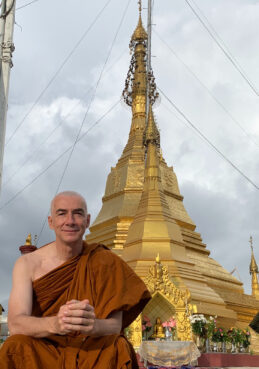
Ricardo Guerrero in Myanmar, in the summertime of 2019, the place he obtained momentary ordination as a Buddhist monk. (Submitted picture)
“The West, whether or not People or Europeans, know virtually nothing of Asia. We stay in a globalized world during which, little by little, the financial and demographic weight is pivoting in direction of Asia, and we can’t proceed the luxurious of creating with out their information,” Ricardo Guerrero, one of many patrons of Lumbini Backyard Basis, says.
Having turned away from Catholicism as an adolescent, Guerrero discovered the religious solutions he was looking for in Buddhism, which didn’t demand religion however somewhat offered a landline from a rational perspective, he stated. He arrange the Hispanic Affiliation of Buddhism in Spain in 2012 and have become a Theravada monk in Myanmar in 2019.
“I don’t have religion,” Guerrero says, a sentiment shared by an rising swath of Spain. Simply 36% of the inhabitants identifies as Catholic, with solely 18% training, based on the Heart of Sociological Analysis, a public physique. This shift makes it much more pertinent and obligatory to advertise the messages of Buddhism, Guerrero believes.
“There’s a manner of understanding life, a collection of values that now we have in some ways misplaced right here,” he stated.
José Manuel Vilanova, president of the Lumbini Backyard Basis, informed Faith Information Service that younger folks, specifically, are involved in Buddhism as a philosophy.
“A philosophy that isn’t guided by a God, which is extra in tune with a extra pure perspective, according to the legal guidelines of the universe,” stated Vilanova.
Buddhism, he stated, nonetheless emphasizes the significance of values equivalent to empathy, compassion and kindness, however “with out having to see it from a spiritual perspective, however somewhat from a humanistic perspective.”
That’s very enticing for younger folks, particularly when many are “ pseudo-religions and different life for the solutions that they don’t get from conventional faith,” Vilanova provides.
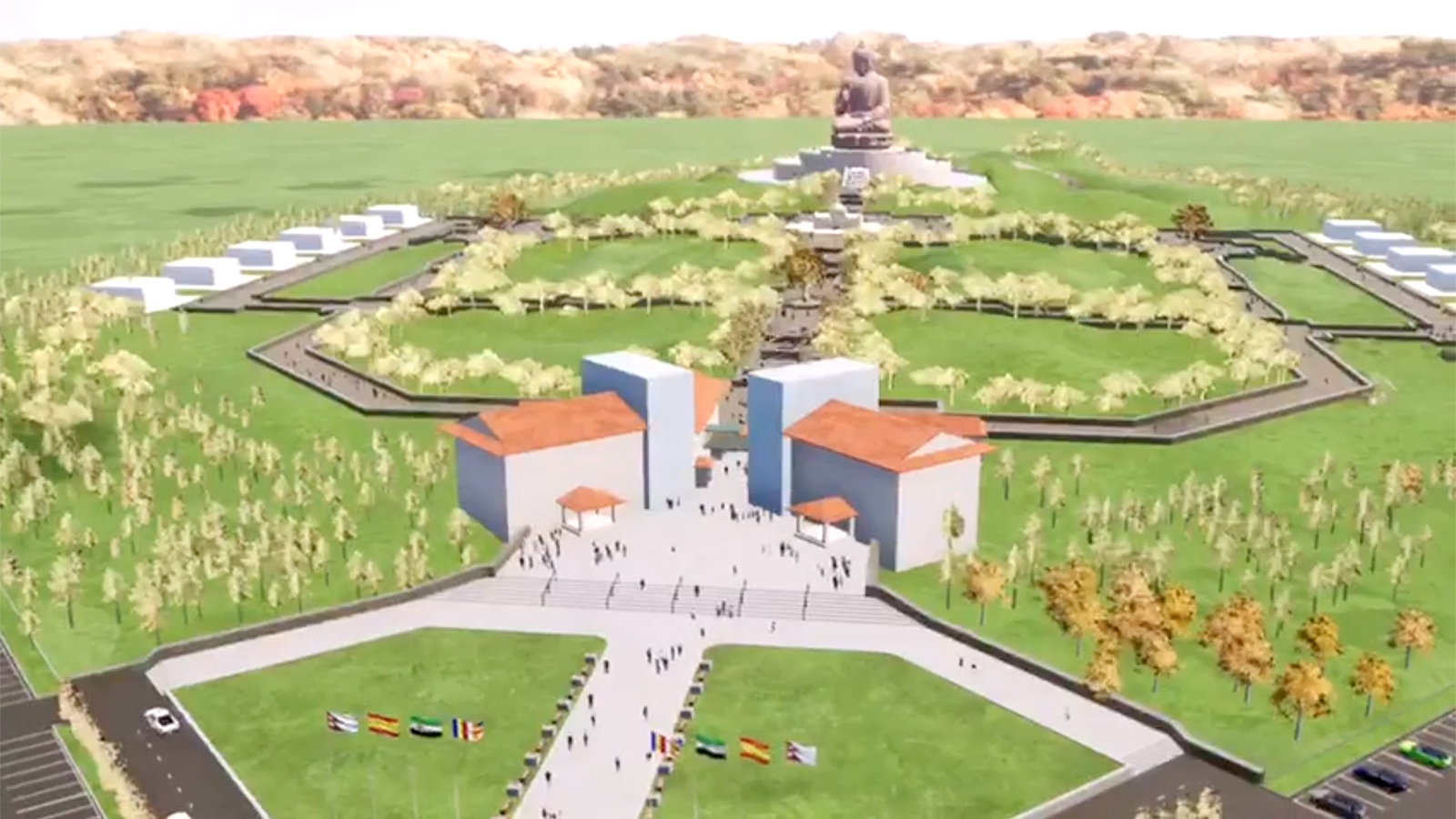
A creative rendering of the proposed Lumbini Backyard Basis growth in Cáceres, Extremadura, Spain, in 2019. (Picture © Engineers’ & Surveyors’ Associates)
The Buddha challenge’s goals are lofty, particularly for a small metropolis, and there are those that query whether or not such grandiosity may doom it in the way in which of the biblical Tower of Babel.
Antonio Cancho Sierra of Guías-Historiadores de Extremadura, a tour information and historian of the area, says everybody he is aware of is “at the very least suspicious” a few challenge that a number of different cities, with extra relevance on the nationwide degree, together with Madrid and Barcelona, have flatly rejected.
The financing seems opaque. No person is aware of precisely the place the large sum of money required for the challenge will come from, says Cancho, and he’s circumspect about the truth that it’s offered by a basis from Nepal, “a rustic a lot poorer than Spain.”
“For the time being, the one factor that has been performed has been to carry a statue of Buddha that has ended up forgotten in a nook of a public constructing,” he says.
Critics level fingers at a tradition and tourism subsidy of 281,229 euros, offered to the muse in 2021, which has allegedly helped to pay for aircraft tickets to Nepal and different Buddhist-practicing international locations for the challenge’s promoters.
Guerrero estimates there have been round 15 journeys overseas however insists the muse obtained the cash by means of correct channels as a result of it’s doing one thing for town’s immense profit — and that lots of these journeys have been paid for out of pocket by the muse’s members.
“We now have opened Extremadura’s doorways to Asia,” Guerrero provides, referring to the Spanish area the place Cáceres is positioned. Making the most of what he phrases their missions to Asia, the muse has promoted the province, its companies and even its soccer groups — in December 2022, the native group, Membership Polideportivo Cacereño, performed two video games towards the Nepalese nationwide group in Pokhara and Kathmandu in a marketing campaign labeled “soccer for peace,” performed in collaboration with the Lumbini Backyard Basis.
If the council paid an company to do that kind of worldwide promoting, the associated fee would have been “multiplied by 10, at the very least,” Guerrero insists, emphasizing that the cash has additionally gone to a slew of cultural and academic actions.
“Ultimately, that cash was spent in our personal province,” says Tomás Vega, the important thing architect on the challenge.
Vega sympathizes with those that assume that constructing a 47-meter statue of Buddha of their yard is likely to be a bit far-fetched. The mere price of the fabric — a proposed 4,800 to six,000 tons of white jade — is a “barbarity,” Vega admits.
However Cáceres is not going to should foot the invoice for its building.
Other than the subsidy, the challenge depends fully on substantial international donations from Asian international locations, based on Guerrero, together with the donation of the Buddha’s constructing blocks from Myanmar, a rustic that produces a lot of the world’s jade provide. Particularly, the Myanmar Gems and Jewellery Entrepreneurs Affiliation “would be the donor,” based on a September 2023 file, “The Nice Buddha Venture,” written by the muse.
“In Europe and America there’s nothing related. It’s onerous to grasp what it means. It’s going to be an icon,” Vega stated.
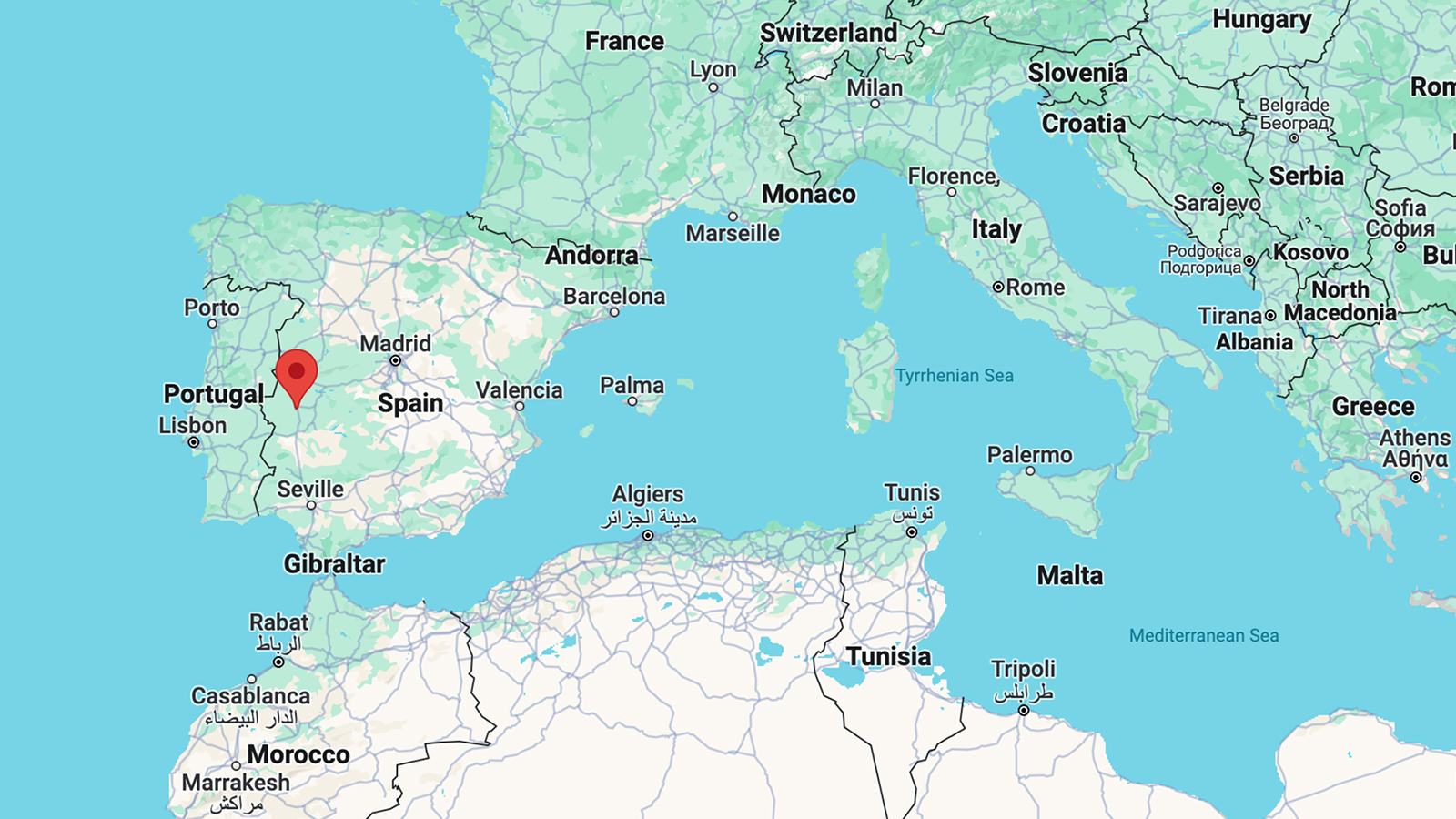
Cáceres, purple marker, in western Spain. (Picture courtesy of Google Maps)
Cáceres is a small metropolis, and now it’s “en la boca,” or within the mouths, of many Asian international locations. Vega is aware of this firsthand, as the muse has allowed him and others to make pleasant inroads with Princess Maha Chakri Sirindhorn of Thailand, the king of Bhutan and necessary monks “on the pope’s degree,” he stated.
Cash and rumors apart, the challenge nonetheless faces a number of obstacles. Environmental issues about utilizing protected public land practically killed it a couple of months in the past.
The unique parcel of land that was picked, and provisionally signed off on, was the Arropé mount that’s a part of a particular zone for protected hen species, or ZEPA. To construct the Buddha, a portion of the ZEPA must be eradicated. Though the native council in the end greenlit the challenge, the talk over the environmental worth of the land continued and, in the end, stakeholders on either side determined to discover a noncontroversial dwelling for the challenge.
“We believed that the challenge may collapse,” Vega admits.
However the brand new yr guarantees a recent begin, with a closing dwelling for the Buddha accepted by town council in late December, in Cerro de los Romanos, about 10 kilometers from the unique plot.
Even Antonio Diaz, president of Adenex, an environmental group in Cáceres, who fought towards the Buddha’s authentic placement, believes the plan for the brand new location is “constructive” for Cáceres.
“Personally, I consider {that a} challenge like that is constructive for a metropolis like Cáceres — small and with not quite a lot of sources — each due to its potential financial repercussions and particularly due to what it may imply for the promotion of tolerance and call between cultures,” Diaz informed RNS.
“However we should attempt to forestall this challenge from having repercussions on the pure surroundings or from conflicting with European directives and concrete planning rules,” he pressured.
Cáceres is a UNESCO World Heritage Metropolis, and Guerrero, Vega and Vilanova all check with the potent “storytelling” factor of bringing the Buddha to this a part of Spain, the place homes nonetheless have Islamic horseshoe arches and eager eyes can spot the hole stone the place Jewish mezuzas was connected. All made ample reference to constructing cultural bridges and persevering with town’s legacy as a bastion of spiritual conviviality.
However as Cancho famous, the reality is just not at all times so picturesque. A big a part of this tri-religious concord is only a good story. “The parable of the three cultures is sustained from the political sphere for ideological causes and, particularly in Cáceres, for vacationer causes, equivalent to selling that market,” Cancho says, referring to the November medieval market.
However earlier than the vacationers can begin arriving, the bottom nonetheless wants breaking.